The scale and intensity of climate hazards make one thing clear: solutions are needed more than ever, and RESIST is stepping in to help communities prepare, adapt, and respond.
RESIST scales solutions across regions and supports Europe in accelerating climate resilience
The RESIST project is entering a decisive phase, with climate adaptation solutions now being actively implemented and transferred between regions facing shared risks. From co-designed early warning systems to inclusive climate shelters, and innovative technologies, partners are not only testing solutions locally but helping them travel across borders. Recent gatherings, such as the sixth in-person general assembly in Terrassa (Spain), have further strengthened collaboration, enabling regions to exchange knowledge, refine approaches, and deepen their joint commitment to resilience.
RESIST partners are increasingly invited to present their work in cities and events across Europe, while new videos, stories, and articles highlight how these solutions are already improving the daily lives of communities in the pilot regions. By combining digital twins, best practices, and transition plans, RESIST continues to support the people and territories most exposed to climate hazards.
The RESIST Communications Team
RESIST's Climate Action in Catalonia
In the region of Catalonia in northeast Spain, the search is on for lasting climate solutions that boost community resilience and inclusion and can be shared with other regions facing similar challenges. RESIST colleagues from the Open University of Catalonia are working hard to involve local citizens in climate solution decision-making and are introducing climate shelters and socially-minded spaces to take refuge from increasingly hot temperatures. Technology is getting a boost, too, as researchers from the Polytechnic University of Catalonia team up with Hyds to design and implement multi-hazard early warning systems.
Strengthening Vulnerable Communities Against Climate Hazards
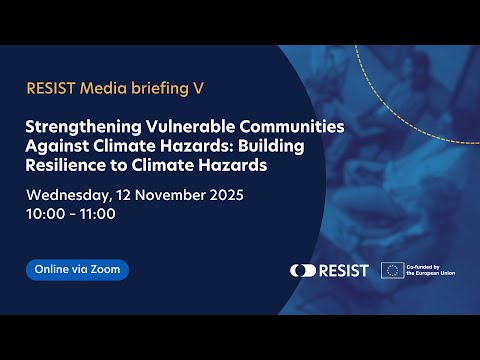
RESIST Media Briefing V took place during the first week of COP30, when discussions around resilience and climate adaptation came into the spotlight. Journalists had the opportunity to explore the latest findings on social fairness in climate adaptation, discover compelling community stories, and access new data and insights to strengthen coverage of climate resilience and social justice, as presented by our speakers Terry Karampini (European Environment Agency), and Maria Cifre and Irra Rodríguez (Open University of Catalonia).
RESIST Partners Gather in Terrassa to Boost Climate Resilience Across Europe
RESIST's 56 partners, representing 12 European regions, met in Terrassa, Spain, for a two-day meeting focused on advancing solutions to multi-hazard climate change impacts. The general assembly offered an opportunity to review progress, exchange knowledge, and demonstrate innovative technologies being developed within the project.
RESIST partners shared concrete results from their regional actions, including Central Portugal’s wildfire prevention work, Puglia’s heatwave response using early warning systems inspired by Catalonia, and Eastern Macedonia & Thrace’s use of the green-blue factor. The session highlighted the exchange of replicable solutions across regions facing similar challenges.
Terrassa is the main testing site in Catalonia, where the Civil Protection Service is working closely with RESIST to implement solutions locally. Discover how these drones enable forest firefighters to act quickly and effectively.
Climate adaptation solutions are at the core of the RESIST project – tested, refined, and created to address the needs of climate-vulnerable regions. Our Handbook of Solutions is a living document that offers an evolving overview of innovations being shared and applied between regions.
This handbook complements the repository of innovative solutions created by KU Leuven, which aims to build a metadata repository that documents Climate Change Adaptation (CCA) solutions, including associated datasets and tools. The result is a visualization platform (GUI) for exploring these solutions in different regions.
Our team hosted the workshop “Collaboration and scaling innovative climate adaptation solutions for resilient territories” as part of the official European Week of Regions and Cities (EWRC). The session highlighted three RESIST regions (Puglia, Eastern Macedonia and Thrace, and Normandy) for an engaged audience of 45 attendees.
Mariana Afonso, project manager at INOVA+ and RESIST operational coordinator, was invited by LandOS to moderate a panel based on the experience of the RESIST Project: ‘Unlocking Land Potential: Digital Solutions for Sustainable Land Use,’ organised at the Embassy of the Netherlands in Portugal.
Participatory day in Blanes, Spain The interactive event took place at the Safa School in Blanes, Catalonia (Spain). Local residents, members of Civil Protection of Blanes City Council, and other members of municipal bodies shared knowledge, experiences, and proposals. The goal? To make Blanes more resilient to climate risks.
CINEA reports on RESIST climate solutions CINEA's media channels highlighted innovative solutions being developed by RESIST such as the early warning system, demo flood-proof houses, and wildfire strategies, among others.
Join the European Climate Pact annual event 2026 in Brussels (Belgium) from the 23 to the 25 March 2026 and expect open conversations, powerful personal stories, creative moments and plenty of ways to get involved – whether you’re there in person or joining online. 23 March will be dedicated to members of the Climate Pact community, while the discussions on 24 and 25 March will be open to everyone interested in climate action.
The Symposium is a key milestone within the University of Macerata’s research project on environmental and climatic migrations, bringing together Italian and European scholars to foster dialogue and co-create practical solutions that balance social justice with environmental sustainability. Conference: 19–20 February 2026 (Macerata, Italy).
Guimarães (Portugal) confirmed as 2026 European Green Capital during EU Green Week. Patrick Child, acting director-general of the European Commission's environment department, signed a letter of intent confirming Guimarães as the 2026 European Green Capital.
Stay connected with RESIST for the latest updates, innovative climate solutions, and upcoming events. Let’s continue building a more resilient and sustainable future together!